
With weight loss injections such as Mounjaro now helping many people lose 15 to 20% of their body weight, far more people are facing this question than ever before.
This article explains why loose skin happens, what each option can realistically achieve, and how to tell when surgery is the answer.
Loose skin that hangs down, folds or overlaps after major weight loss will not tighten on its own and no topical creams, injections or ‘skin-tightening’ devices will remove it.
Once skin has been stretched over a long period, its collagen and elastin are permanently changed. When there is a genuine excess of skin, surgery to remove it is the only treatment that works reliably.
This article is the first in a series of five:
What can be done about loose skin after weight loss?
What is the difference between a tummy tuck and a body lift?
What is a 360 body lift?
Would I be suitable for a body lift after weight loss?
What is recovery like after a body lift?
Why doesn't skin shrink back after weight loss?
Skin owes its ability to recoil to two proteins in the dermis: collagen, which gives strength, and elastin, which gives stretch and snap-back. When skin is stretched for years by excess weight, both are damaged.
The collagen fibres become disorganised and the elastin fibres fragment. Studies of skin removed after major weight loss show these changes persist after the weight has gone, which is why the skin stays loose rather than shrinking to fit the smaller body.
How much skin is left over depends on several factors:
How much weight was lost. Losing 5 stone leaves far more redundant skin than losing 1 stone.
How long the weight was carried. Skin stretched for 20 years recovers less than skin stretched for 2 years.
Age. Collagen production falls steadily from early adulthood, so older skin has less capacity to recover. Read more about where has my collagen gone?
Genetics and skin type. Some people have naturally more elastic skin, and stretch marks are a sign that the dermis has already torn.
Sun exposure and smoking. Both break down collagen and elastin over time.
Pregnancy. Previous pregnancies add to the stretch, particularly on the abdomen.
The skin of the abdomen, upper arms, inner thighs and breasts is usually most affected, because these areas store the most fat and the skin there is thinner.
Does losing weight on Mounjaro or other weight loss injections make loose skin worse?
The injections do not damage the skin, but they make significant weight loss far more achievable. In clinical trials, people lost an average of around 15% of their body weight on semaglutide (Wegovy, Ozempic) and around 20% on the highest dose of tirzepatide (Mounjaro).
The amount of weight lost is the main driver of loose skin. Rapid loss may add to it by giving the skin less time to adapt, although evidence on speed is limited.
The term "Ozempic face" describes the same mismatch in the face, where fat volume is lost faster than the skin can adjust. Read about Ozempic face here.
Anyone losing this much weight should expect some loose skin, particularly if they are over 40 or carried the weight for many years, and any surgical result depends on the weight staying off if the medication is later stopped.
Will my skin tighten up on its own?
Some of it will. Skin continues to remodel for 6 to 12 months after weight loss, and mild looseness, particularly in younger people who lost a moderate amount, often improves noticeably.
Skin that folds over itself, hangs below a natural crease or stays loose when you pinch it and let go has lost its elasticity for good. So waiting longer is unlikely to improve it.
Can exercise, diet or creams help?
They support your body and skin health, but they cannot remove excess skin. Strength training builds muscle beneath the skin and protects muscle mass during rapid weight loss, which can make mild looseness less visible.
Eating enough protein supports healing and becomes important if surgery is considered later. Firming creams, including those with retinoids or peptides, can improve texture and fine lines, but none has been shown to tighten loose skin after weight loss to any meaningful degree.
What can non-surgical skin tightening achieve?
Treatments such as radiofrequency, radiofrequency microneedling, focused ultrasound and biostimulators like Sculptra stimulate new collagen. They can improve mild crepiness or slight looseness, for example on the inner arms, above the knees or on the abdomen after moderate weight loss.
The improvement is gradual and modest, potentially resulting in firmer, smoother skin rather than less of it. Where skin hangs or folds, these treatments are unlikely to make a visible difference however many treatments are booked.
When is surgery the only real answer?
Surgery is the right conversation when loose skin hangs or folds, when it causes physical problems, or when it stops you enjoying the body you have worked hard for.
Common signs include:
an apron of skin that hangs over the pubic area or the top of the thighs
rashes, soreness or infections in skin folds that keep coming back
difficulty keeping skin folds clean and dry
skin that chafes during exercise or makes clothes hard to fit
folds that wrap around the sides and back, not just the front
Skin removal surgery, also called body contouring, cuts away the excess skin and tightens what remains. The trade-off is a scar, which is placed where clothing can usually hide it.
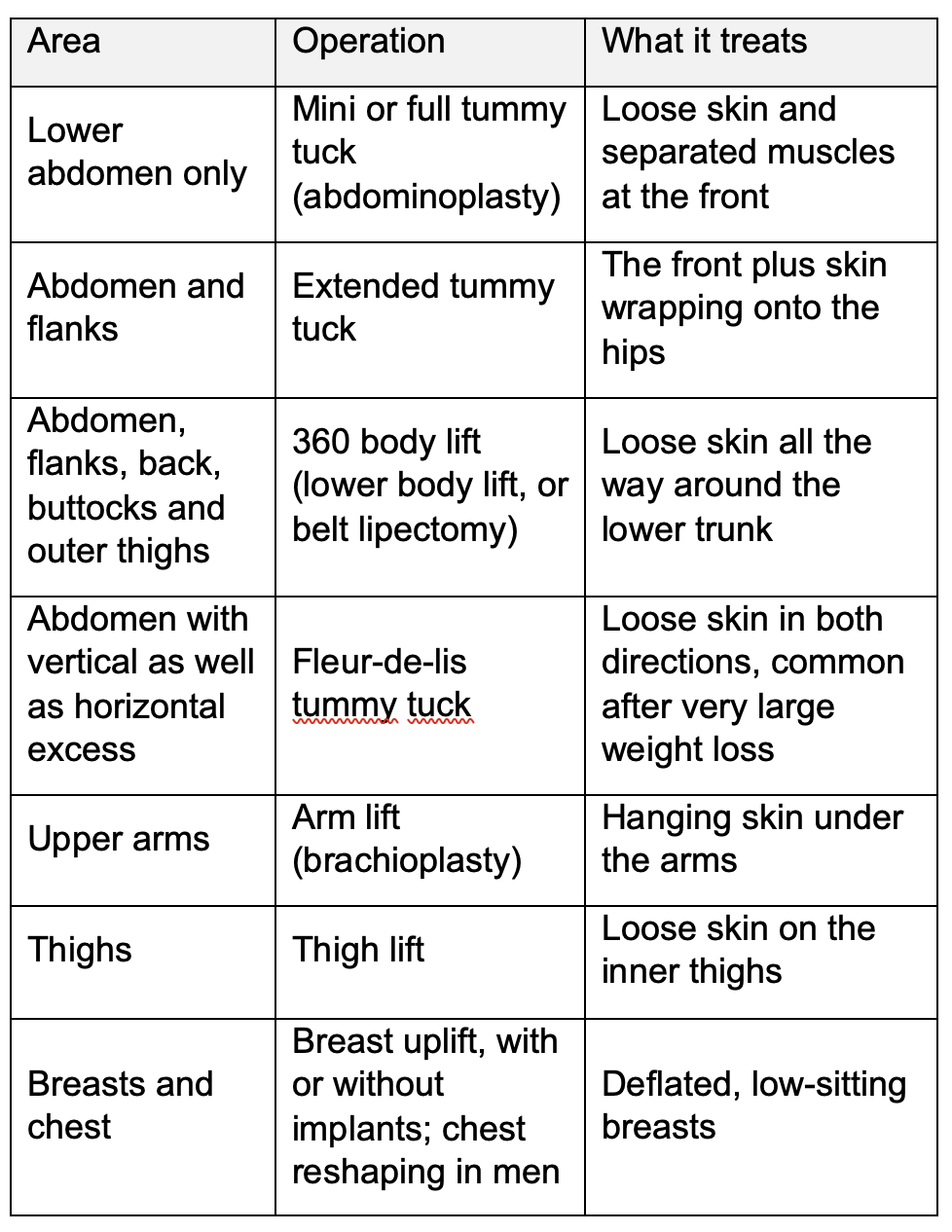
Which operation treats which problem area.
Many people who have lost a large amount of weight assume a tummy tuck will solve the problem, only to find that most of their excess skin sits around the sides and back. Our article on the difference between a tummy tuck and a body lift explains how surgeons decide between them.
When should I start thinking about skin removal surgery?
The best time is once your weight has been stable for at least 3 to 6 months, and usually 12 to 18 months after bariatric surgery. Operating while weight is still falling means more loose skin may appear afterwards, and regaining weight can stretch the repair.
Surgeons generally prefer a body mass index close to or below 30 to 32, because complication rates rise with higher BMI.
If you are taking a weight loss injection, there are extra points to discuss:
Whether you plan to stay on the medication. Many people regain weight after stopping, which would affect the result.
Your anaesthetic. These medicines slow stomach emptying, so the anaesthetist will need to know you are taking one and may give specific instructions before surgery.
Your nutrition. Reduced appetite can leave protein, iron and vitamin levels low, and these may need to be checked and corrected before an operation.
It is perfectly reasonable to have an early consultation while you are still losing weight. It helps you understand what is likely to be needed, so you can plan rather than guess. Our article on whether you would be suitable for a body lift covers these criteria in more detail.
How do I find out what would work for me?
The most useful first step is a consultation where someone examines the skin itself, not just your photographs. At The Cosmetic Doctors Company, we can advise on both sides of the question. Where laxity is mild, we can tell you whether non-surgical treatment is worthwhile.
Where there is true excess skin, surgical consultations are with Consultant Plastic Surgeon Ms Helen McEvoy, who can explain which operation fits your shape and what recovery would involve.
Consider Your Next Step
A consultation is where every good treatment starts. There will no obligation to proceed. The aim is to provide information and clarity, not pressure to have an opeation..
To arrange a consultation with Ms McEvoy please use the links below to telephone or email or to fill out our contact form click here.
References
Light D, Arvanitis GM, Abramson D, Glasberg SB. Effect of weight loss after bariatric surgery on skin and the extracellular matrix.
Plast Reconstr Surg. 2010;125(1):343-351.
Song AY, Jean RD, Hurwitz DJ, et al. A classification of contour deformities after bariatric weight loss: the Pittsburgh Rating Scale.
Plast Reconstr Surg. 2005;116(5):1535-1544.
Biörserud C, Olbers T, Fagevik Olsén M. Patients' experience of surplus skin after laparoscopic gastric bypass. Obes Surg. 2011;21(3):273-277.
Kitzinger HB, Abayev S, Pittermann A, et al. After massive weight loss: patients' expectations of body contouring surgery. Obes Surg. 2012;22(4):544-548.