
Do I Need a Breast Uplift, Implants, or Both?
Whether you need a breast uplift, implants, or both depends on one question: is the problem the size of your breasts, their position, or both?
Implants add volume. An uplift corrects position and shape. When a breast has lost volume and dropped, neither operation on its own will fully restore it, and a combination is often the answer.
This is a common source of confusion. Many women assume implants will lift a breast that has dropped, or that an uplift will make a deflated breast fuller. Neither is reliably true.
This article explains how surgeons tell the difference, when each approach makes sense, and what the evidence says about doing both together.
This is the second of four articles, by Ms McEvoy on breast uplift (mastopexy):
Do I need an uplift, implants, or both?
How long does a breast uplift last?
Should I wait until I’ve finished having children (or losing weight) before an uplift?
What is the difference between an uplift and implants?
An implant increases the volume of the breast. An uplift, or mastopexy, moves the nipple and breast tissue higher, removes excess skin and reshapes what remains. One changes size; the other changes position and shape. They solve different problems.
This matters because a breast that has changed after pregnancy, breastfeeding or weight loss has often been affected in both ways.
Volume has been lost, particularly from the upper part of the breast, and the skin has stretched so that the nipple and breast tissue sit lower than they did.
The table below gives a simplified guide to how the main concern usually maps to the approach.
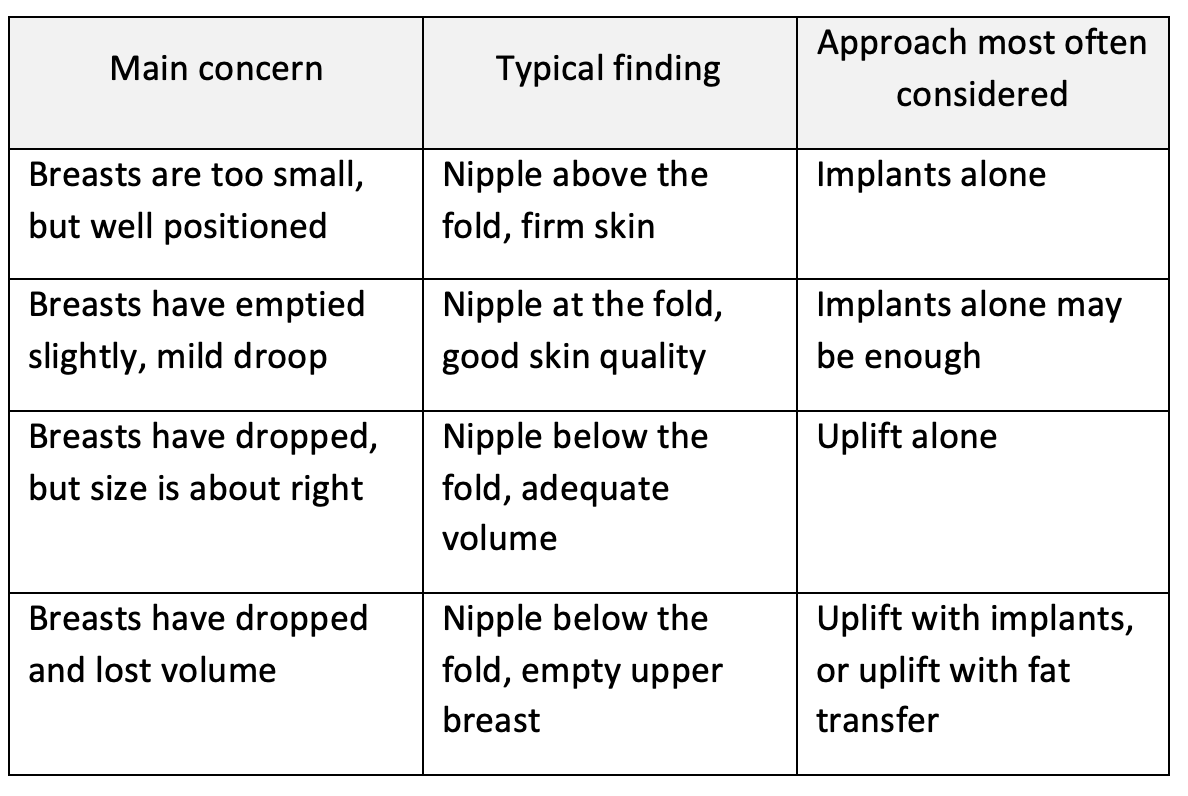
This table is a starting point, not a prescription. Skin quality, chest wall shape, asymmetry and personal preference all influence the final recommendation.
When might implants alone be enough?
Implants alone can work well when the nipple still sits at or above the crease beneath the breast and the main problem is lost or insufficient volume. In these cases, filling the breast from behind can restore shape and give a modest impression of lift, without the additional scars of an uplift.
This typically applies to women with pseudoptosis, where the nipple is well positioned but the lower breast has slumped, or with very mild droop and good skin quality.
An implant fills the emptied skin envelope and can make the breast look firmer and higher.
The limit is easy to overlook. An implant placed beneath a breast that has genuinely dropped does not lift it. Instead, the implant sits where it is placed while the breast tissue continues to hang over and below it, sometimes producing a double contour known as a waterfall deformity.
Choosing implants alone to avoid uplift scars, when an uplift is really needed, is one of the more common reasons for disappointment and revision surgery.
When is an uplift alone the right answer?
An uplift alone is usually the right choice when the breasts have dropped but still contain enough tissue to give a size and shape the patient is happy with. Moving that tissue higher and tightening the skin around it restores a more youthful contour without the need for an implant.
Many women are content with their cup size and simply want their breasts to sit where they used to. For them, avoiding an implant has real advantages.
There is no device to monitor or eventually replace, no risk of capsular contracture, and none of the longer-term implant questions we discuss elsewhere in this series.
The trade-off is that an uplift on its own does not reliably create fullness in the upper part of the breast. Shape is improved and the breast sits higher, but if a rounded upper pole is the main goal, the uplift alone may not deliver it. That distinction is worth discussing openly before surgery rather than discovering afterwards.
When might you need both?
A combined uplift and implant, known as an augmentation mastopexy, is usually recommended when the breast has both dropped and lost significant volume. The uplift corrects position and removes loose skin; the implant restores fullness, particularly in the upper breast.
This is a common picture after several pregnancies or major weight loss, where the skin envelope has stretched and the breast tissue inside it has diminished.
Raising that tissue alone leaves a smaller, flatter breast than many women want, while adding an implant alone leaves the breast hanging below it.
The combined operation is more complex than either procedure on its own, because the two work in opposite directions. The implant expands the skin envelope while the uplift tightens it, and the surgeon must balance the two so that the skin closes comfortably and the nipple sits in the right place.
It also brings together the considerations of both operations: the scars of an uplift, and the long-term care and eventual replacement of an implant.
Should an uplift and implants be done together or in two stages?
For most suitable patients, an uplift and implants can be safely done in a single operation, but some patients are better served by two separate stages several months apart.
The choice depends on how much skin needs removing, how much volume is being added, and the patient's individual risk factors.
The largest systematic review of single-stage surgery, published in Plastic and Reconstructive Surgery in 2014, pooled 23 studies and 4,856 operations. The overall complication rate was 13.1%.
The most common problem was some droop returning, at 5.2%, followed by poor scarring at 3.7%. Serious complications such as infection and significant bleeding were each under 2%. The re-operation rate was 10.7%.
Individual surgical series report higher revision rates, generally between 17% and 23%, often for minor adjustments to shape, symmetry or scars. That is worth knowing in advance.
A two-stage approach avoids some of the competing tensions of the combined operation and makes each step more predictable, but it means two operations and two recoveries.
It is often favoured where there is a very large excess of skin, marked asymmetry, or after major weight loss.
Could fat transfer replace the implant?
For some women, fat transfer can add modest volume alongside an uplift without the need for an implant.
Fat is taken by liposuction from an area such as the tummy or thighs, purified, and injected into the breast, where a proportion of it establishes a blood supply and survives permanently.
The appeal is clear. The added volume is the patient's own tissue, it looks and feels natural, and there is no implant to monitor or replace.
For a patient who needs only a small increase in fullness, particularly in the upper breast, it can be an excellent complement to an uplift.
The limitations are equally clear. The volume that can be added in one session is modest, a variable amount of the transferred fat is reabsorbed in the first few months, and some patients need more than one session.
Patients also need enough spare fat to harvest. Where a more substantial or predictable increase in size is wanted, an implant remains the more reliable option.
So how is the right approach decided?
The right approach is decided at consultation, by examining the breasts and talking through what the patient wants to change. A surgeon will look at where the nipple sits relative to the crease beneath the breast, how much breast tissue remains, the quality and stretch of the skin, and any difference between the two sides.
Just as important is the conversation about goals. A patient who wants her breasts to sit higher but stay the same size needs a different operation from one who wants more fullness.
Both need to understand the scars, recovery and long-term considerations of what is proposed.
Consider Your Next Step
At The Cosmetic Doctors Company, breast surgery is carried out by Ms. Helen McEvoy, a Consultant Plastic Surgeon at St Thomas' Hospital in London. In her private practice she undertakes breast uplift, augmentation, reduction, and implant removal and exchange, so she is well placed to recommend whichever approach genuinely suits the individual patient.
A consultation is where every good treatment starts. There will no obligation to proceed. The aim is to provide information and clarity, not pressure to have an operation.
To arrange a consultation Ms McEvoy please use the links below to telephone or email or to fill out our contact form click here.
References
Khavanin N, Jordan SW, Rambachan A, Kim JYS. A systematic review of single-stage augmentation-mastopexy.
Plastic and Reconstructive Surgery. 2014;134(5):922–931.
Stevens WG, Macias LH, Spring M, Stoker DA, Chacón CO, Eberlin SA. One-stage augmentation mastopexy: a review of 1192 simultaneous breast augmentation and mastopexy procedures in 615 consecutive patients.
Aesthetic Surgery Journal. 2014;34(5):723–732.
Calobrace MB, Herdt DR, Cothron KJ. Simultaneous augmentation/mastopexy: a retrospective 5-year review of 332 consecutive cases.
Plastic and Reconstructive Surgery. 2013;131(1):145–156.