
What Can a Breast Uplift Actually Achieve?
A breast uplift, known surgically as a mastopexy, raises the breast and reshapes it, so that it sits higher on the chest wall and looks firmer and more youthful.
What it does not do is add volume. That single distinction explains most of what an uplift can and cannot achieve, and it is the point we find patients are least sure about when they first come to see us.
In this article Ms Helen McEvoy FRCS(Plast), Consultant Plastic Surgeon at Guys and St Thomas’ Hospital, explains what a breast uplift changes, why breasts change shape in the first place, how surgeons assess the degree of droop, and what patients can realistically expect. It is the first in a series on breast uplift surgery, which sits alongside our articles on breast augmentation and breast implants.
This is the first of four articles, by Ms McEvoy on breast uplift (mastopexy):
What can a breast uplift actually achieve?
How long does a breast uplift last?
Should I wait until I’ve finished having children (or losing weight) before an uplift?
Note: areolar is the medical word describing the circular, pigmented area of skin surrounding the nipple.
What is a breast uplift?
A breast uplift is an operation that lifts the breast tissue and nipple to a higher position, removes excess stretched skin, and reshapes the remaining tissue into a firmer, more rounded form.
The operation works on three things. The nipple and surrounding areola are moved upwards, and the areola can be made smaller if it has stretched. The breast tissue itself is reshaped and supported internally. And the loose skin envelope is tightened by removing the excess. Together these restore the shape and position the breast had before it changed, rather than creating a new breast.
Because no tissue is added, the breast after an uplift is usually much the same size as before, and sometimes slightly smaller once excess skin has been removed. Patients who also want more fullness, particularly in the upper part of the breast, may need an implant or fat transfer as well, which we cover in a separate article.
Why do breasts change shape over time?
Breasts change shape because the skin and internal support of the breast stretch, while the volume inside them rises and falls. The breast has no muscle of its own. Its shape depends on the elasticity of the overlying skin and on a network of fine connective tissue bands (Cooper's ligaments) that run through the breast tissue.
Pregnancy and breastfeeding are the most common causes. The breast enlarges considerably during pregnancy and lactation, stretching the skin and ligaments, and then often loses volume afterwards. Studies of women with breast droop (ptosis) have found that the number of pregnancies, a higher body mass index (BMI), a larger bra cup size, smoking history and age are all associated with greater droop. Interestingly, breastfeeding itself has not been shown to be an independent cause; the changes of pregnancy appear to matter more.
Significant weight loss has a similar effect, leaving a skin envelope that is too large for what it contains. And with age, skin gradually loses collagen and elastin, so even women who have never been pregnant will see some change over time.
How do surgeons assess the degree of droop?
Surgeons grade breast droop, or ptosis, mainly by where the nipple sits in relation to the inframammary fold, the crease where the underside of the breast meets the chest wall. The most widely used system was described by the French plastic surgeon Paule Regnault in 1976, and it remains the common language of breast surgery today.
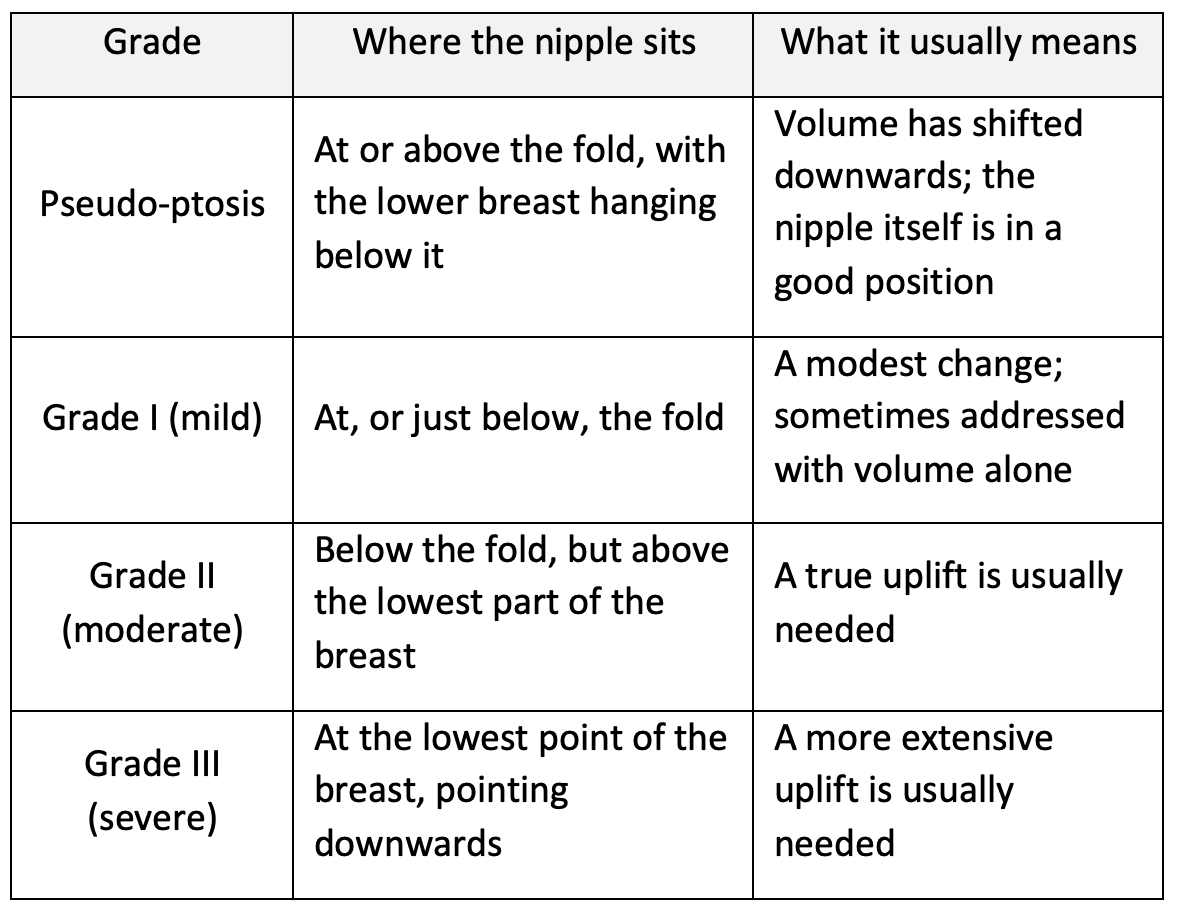
Regnault P. Breast ptosis: definition and treatment.
Clinics in Plastic Surgery. 1976;3(2):193–203.
The grade matters because it guides which technique is suitable, how much skin needs removing, and therefore the pattern of scarring. Grading is only part of the assessment, though. Skin quality, the amount of breast tissue present, any asymmetry between the two sides, and the patient's own goals all shape the final recommendation.
What can an uplift change, and what can it not?
An uplift can reliably change the position, shape and proportions of the breast. It cannot add size, create lasting fullness in the upper breast on its own, or stop the breast from continuing to age.
What a breast uplift can do:
Raise the nipple and areola to a more youthful position on the breast
Reduce the size of stretched or enlarged areolae
Remove loose, excess skin and tighten the skin envelope
Reshape the breast into a firmer, more projected form
Improve the symmetry between the two breasts
What a breast uplift cannot do:
Increase cup size; the breast may be slightly smaller afterwards
Reliably restore upper pole fullness, the rounded curve above the nipple, when little breast tissue remains
Prevent future change from pregnancy, weight fluctuation or ageing
Be performed without permanent scars
The second list is not a reason for pessimism. It is the reason a careful consultation matters, because a patient whose main concern is lost volume may be better served by an implant, fat transfer, or a combined procedure, and a patient whose main concern is shape may need nothing more than the uplift itself.
What about the scars?
Every breast uplift leaves permanent scars, and their length depends mainly on how much skin needs to be removed. The more droop there is, the more skin must go, and the longer the scar. There are three main patterns.
Around the areola only (periareolar). Suitable for mild cases, where only a small amount of lift is needed.
Around the areola and straight down to the fold, often called a vertical scar. This is a common choice for moderate droop.
Around the areola, down, and along the fold, often called an inverted T scar. This is used where there is a larger excess of skin, often after major weight loss or in more severe droop.
Scars are usually red and firm for the first few months, then gradually soften and fade over twelve to eighteen months. The horizontal part of an inverted ‘T’ scar sits in the crease beneath the breast, and the vertical part is usually well hidden by a bra or bikini. Most patients find that a well-healed scar is a fair exchange for the change in shape, but it is a trade worth thinking through before deciding.
How satisfied are patients after a breast uplift?
Satisfaction after a breast uplift is high. A 2019 systematic review in the Journal of Plastic, Reconstructive and Aesthetic Surgery pooled 34 studies covering 1,888 patients who had an uplift without implants. Only 1.3% were left with a breast shape they were unhappy with, and the overall complication rate was 10.4%.
The most common complications were scar-related problems, at around 3%, and issues with the nipple and areola, such as asymmetry, distortion or reduced sensation, at around 2.9%. Most were minor. The authors' conclusion was that the operation is reliable and can be tailored to the individual patient, but that scars, asymmetry and the possibility of some droop returning should always form part of the consent discussion.
That is a fair summary of how we think about it too. A breast uplift is not a risk-free operation, but in the right patient it delivers a dependable and lasting improvement in shape, and the large majority of women are pleased with the outcome.
Who is a good candidate for a breast uplift?
The best candidates are women whose main concern is the shape and position of their breasts rather than their size, who are at a stable weight, and who have finished, or are confident they have finished, having children.
These factors matter because they protect the result. Further pregnancies and significant weight changes stretch the skin again and can undo much of what surgery achieved, so many surgeons advise waiting until family planning is complete and weight has been steady for some months. Smoking slows wound healing and increases the risk of complications, particularly around the nipple, and stopping well before surgery is strongly advised.
Good candidates also have realistic expectations. An uplift will make the breasts look higher, firmer and more youthful, but it will not reproduce the breasts of a twenty-year-old, and it comes with scars. Women who want more volume as well as lift may need a combined approach, and those with very large, heavy breasts may be better suited to a breast reduction, which lifts and reduces at the same time.
How do I find out whether a breast uplift is right for me?
The right starting point is a consultation with a consultant plastic surgeon who can examine you, assess the degree of droop, and talk through whether an uplift alone, or an uplift combined with volume, would best meet your goals.
At The Cosmetic Doctors Company, breast surgery is carried out by Ms Helen McEvoy, a Consultant Plastic Surgeon at St Thomas' Hospital in London.
If you would like to talk through whether a breast uplift might be right for you, we would be pleased to arrange a consultation.
References
Breast ptosis: definition and treatment. Regnault P.
Clinics in Plastic Surgery. 1976;3(2):193–203.
Rinker B, et al. The effect of breastfeeding on breast aesthetics.
Aesthetic Surgery Journal. 2008;28(5):534–537.
Systematic review of outcomes and complications in nonimplant-based mastopexy surgery.
Journal of Plastic, Reconstructive and Aesthetic Surgery. 2019;72(2):243–272.