
Recovery from a body lift takes longer than recovery from a tummy tuck.
It is a longer operation with the scar and stiches going all the way around the body.
Please note that this article offers general advice applicable to most patients having a 360 Body Lift procedure.
However, each individual patient’s recovery will depend on the exact nature of the operation, their age, general health, nutritional status and support from relatives and friends during the first weeks after surgery. Before making any firm plans you should talk it through with your surgeon.
This article looks at hospital stay, the first weeks at home, when everyday activities can resume, and what you can do to help yourself heal well.
Knowing what to expect at each stage makes recovery easier to plan.
In Summary:
1-2 nights in hospital after surgery
regular, gentle mobilisation and walking
return to see your surgeon 7-10 days post-op
stiches removed 10-14 days
help at home for the first 2 weeks
return to desk-based work after 3 weeks
back to strenuous exercise at around 8 weeks
most swelling has settled by 3 months, and the scar takes 12 months to fully mature.
This is the final article in a series of five about 360 Body Lift:
What happens in hospital?
Most people spend one or often two nights in hospital. You will wake with dressings around your trunk, a compression garment, and usually two to four thin drains, which are fine tubes that remove excess fluid from under the skin.
Your drains are usually removed before discharge home. Pain is controlled with regular painkillers, and it is usually described as tightness and soreness rather than sharp pain.
Nurses will help you out of bed and walking on the first day. Early mobilisation lowers the risk of blood clots, along with compression stockings and in most cases, daily blood-thinning tablets or injections.
You will find it more comfortable to walk slightly bent forward for the first week or two. This is to take tension off the front of the wound. Most people go home once they are walking comfortably and their pain is well controlled with tablets.
What are the first two weeks at home like?
The first two weeks are the most restricted. You will need someone at home to help with shopping, cooking and lifting, and anyone with young children will need help with their care.
Getting comfortable can be awkward because the wound runs around the back as well as the front, so many people sleep on their back with pillows under the knees and the upper body slightly raised. Short, gentle walks several times a day are encouraged.
How long do I wear a compression garment?
Most surgeons ask patients to wear a compression garment day and night for around 6 weeks, taking it off only to shower. It supports the tissues, helps control swelling and reduces the chance of fluid collecting under the skin.
Having two garments makes washing easier (one on whilst one in the wash). Some surgeons recommend continuing during the day for a few more weeks, particularly during exercise.
When can I return to work, drive and exercise?
Everyone heals at a different pace, and your surgeon will guide you, but these are typical timescales:
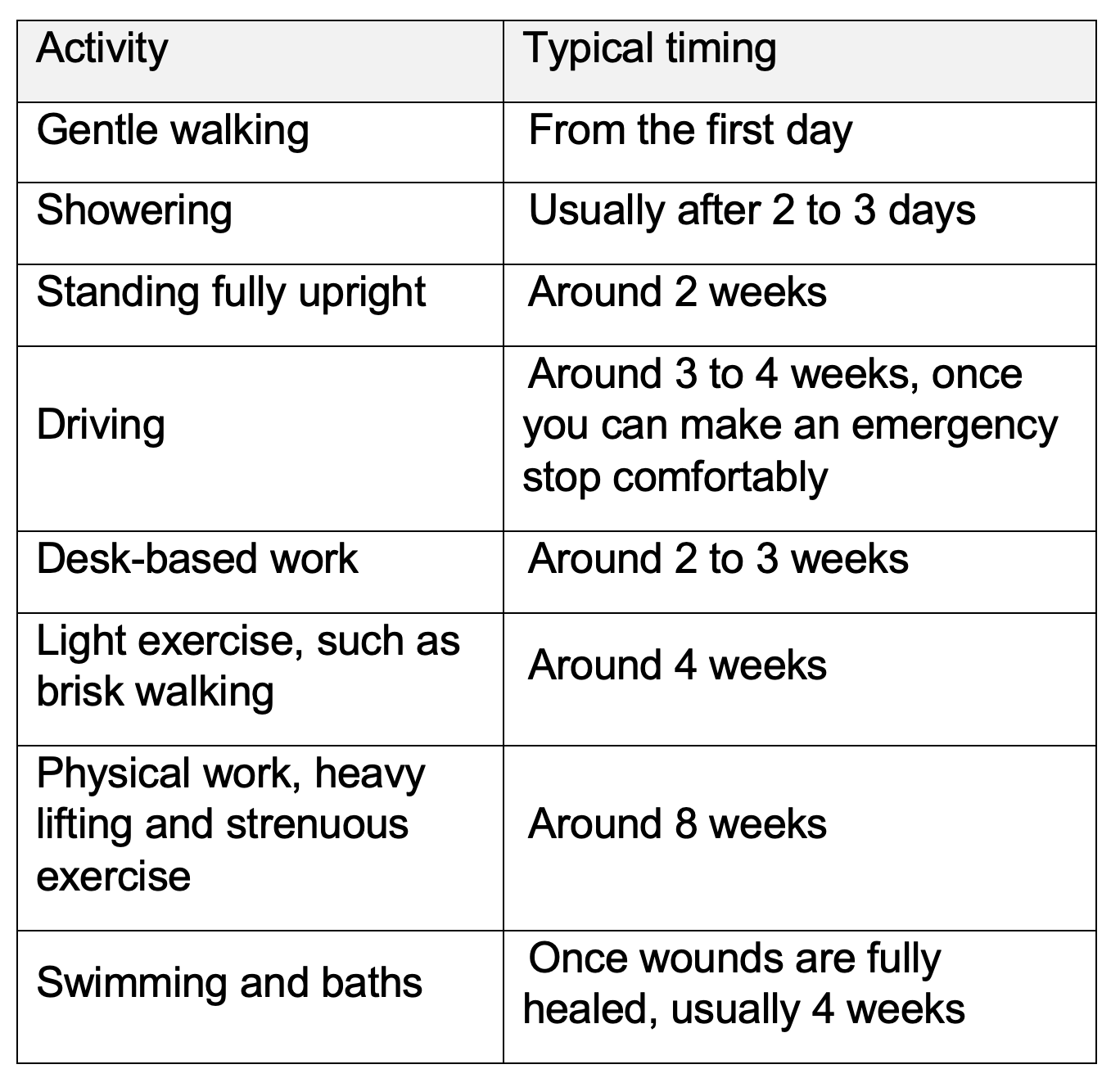
Summary of recovery
What should I watch out for?
Some swelling, bruising, numbness and tightness are normal. Small areas where the wound is slow to heal, often at the hips or where the front and back scars meet, are also common and usually settle with dressings.
Contact your surgical team promptly if you notice:
increasing redness, heat or pain around the wound,
a fever
discharge that is cloudy or smells unpleasant
a swelling that feels like a fluid-filled balloon under the skin, which may be a seroma
the wound opening up
Seek urgent medical help if you have pain or swelling in one calf, chest pain or sudden breathlessness, as these can be signs of a blood clot.
When will I see the final result?
You will notice the change in shape straight away, but the final result takes time. Most swelling settles over the first 1-2 months, with the last of it, particularly over the lower abdomen and hips, taking up to 6 months.
Numbness around the abdomen and lower back gradually improves over several months, although a small area may stay permanently less sensitive.
The scar is usually pink and raised for the first few months, then slowly flattens and fades over 12 to 18 months. Judging the result before then can be misleading, so your surgeon will usually review you at intervals over the first year.
How can I help my recovery?
The things that make the biggest difference are simple. Avoid all nicotine for at least 6 weeks after surgery, as well as before it. Eat enough protein, which matters even more if a weight loss injection has reduced your appetite.
Keep walking little and often, wear your compression garment as advised, and avoid lifting or straining until you are cleared to do so. Over the longer term, keeping your weight stable is the most important way to protect your result.
How do I plan my recovery?
The best preparation starts at consultation. At The Cosmetic Doctors Company, surgical consultations are with Consultant Plastic Surgeon Ms Helen McEvoy, who will talk you through what recovery will involve for you, how much time to set aside, and what support you will need at home, so there should be no surprises afterwards.
Consider Your Next Step
A consultation is where every good treatment starts. There will no obligation to proceed. The aim is to provide information and clarity, not pressure to have an operation.
To arrange a consultation please use the links below to telephone or email or to fill out our contact form click here.