
Here Is What Probably Went Wrong.
A conversation we have regularly and one that almost always has the same explanation.
Dr Peter Forrester writes about a familiar story :
She is in her 50’s or 60’s. She comes to the clinic to discuss the possibility of having a Botox treatment. But she is hesitant because she tried it once, several years ago, and did not like the result. In fact, she disliked it sufficiently that she did not even go back for the follow-up appointment.
She decided that Botox was simply not for her.
But time has passed. She has noticed more signs of facial ageing. She has thought about Botox again. And this is the part I find genuinely touching, she says: "I thought I'd come and see you." She is placing her trust in me for her second attempt.
After 25 years in aesthetic medicine, I know exactly what she is going to say next. I ask what she did not like about her previous treatment, and the answer is almost invariably: "It made my brows feel very low and heavy."
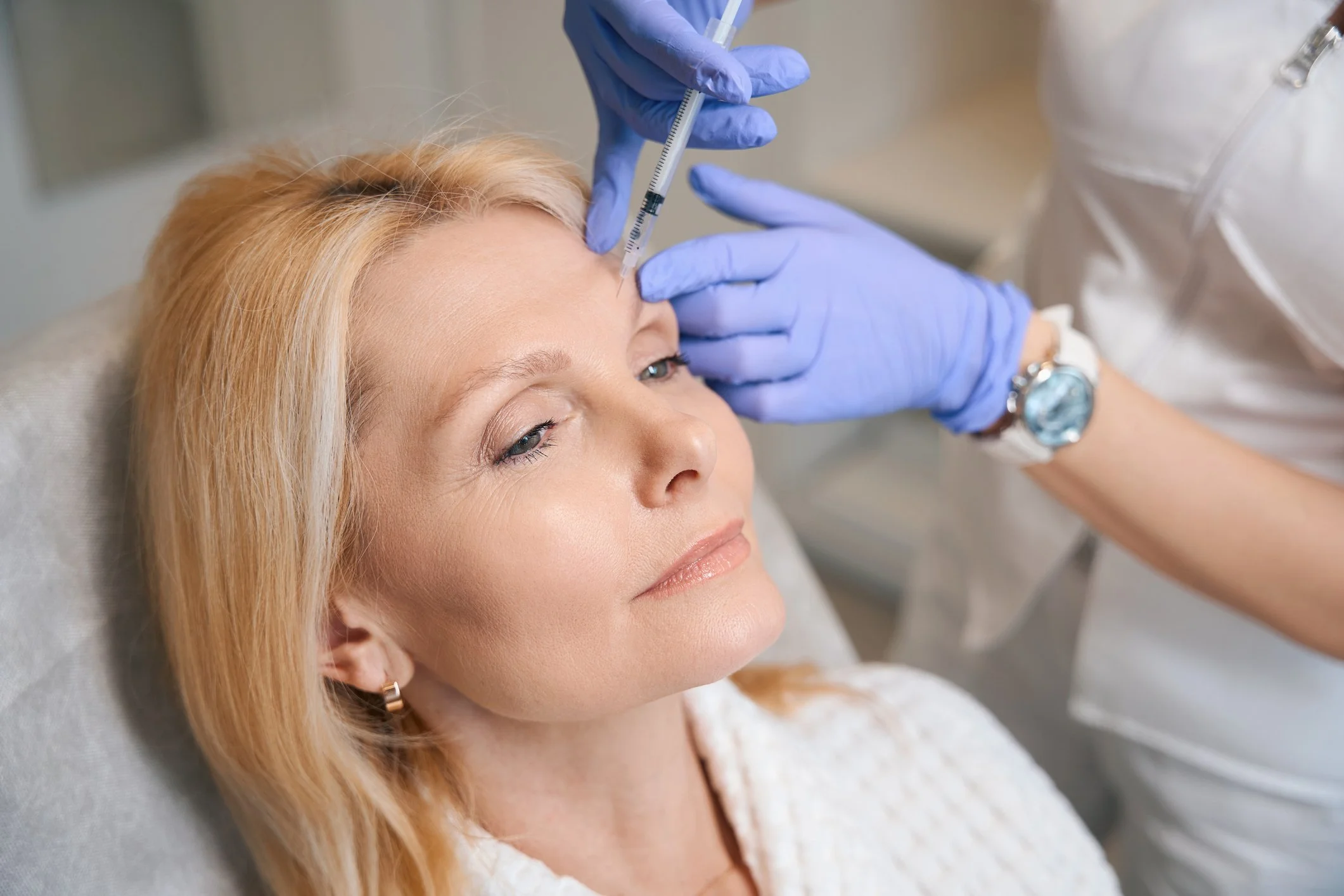
Many woman are put off Botox having experienced a feeling of heaviness in their brows.
Why that happens — the frontalis muscle and the ageing brow
The frontalis is the large muscle, across the forehead, responsible for raising the brows and producing horizontal creasing. In younger patients it works straightforwardly; it lifts the brows when needed and rests the rest of the time.
But as we age, the brow has a natural tendency to drop. The skin above the eye becomes heavier, the supporting structures less firm, and gravity does what gravity does.
Many people in their fifties and sixties unconsciously compensate for this by maintaining a little extra resting tone in their frontalis muscle. This keeps the brows slightly elevated without realising they are doing it. It is an entirely automatic response to the gentle but persistent downward pull of an ageing brow.
When a practitioner treats the horizontal forehead lines with botulinum toxin and relaxes the frontalis muscle too completely, particularly too low on the forehead, that compensatory tone disappears. The brows descend. The upper eyelids feel heavier. The patient looks and feels tired in a way that is immediately apparent and deeply unwelcome.
This is not a side effect of botulinum toxin. It is the predictable consequence of a treatment that did not take the individual anatomy of an older brow into account.
Read more articles and information about anti-wrinkle injections.
The template problem
In my experience, inadequately trained practitioners are frequently taught to inject using a standard template of injection points - the same pattern, in the same positions, on every patient. They have not the medical training that allows them to assess each patient’s individual muscle anatomy and muscle action.
That template was almost certainly developed and tested on younger patients, in whom the brow position is naturally secure and the frontalis can be relaxed more freely without consequence.
However, it does not transfer well to the older patient. The brow that is already fighting gravity, and that is being held in position by compensatory frontalis tone, needs a very different approach. Namely, one that can only be determined by assessing the individual patient's brow position, their muscle action, and the dynamic relationship between the two.
A practitioner who applies the same injection template to a fifty-five year old that they use on a thirty year old is not assessing the patient in front of them. They are following a pattern. And the patient is the one who pays the price.
W explore this theme in Why Good Botox Isn't Just About the Injections.
What the correct, considered approach looks like
When I see a patient with this history, the treatment plan is deliberately modest and with injection points deliberately high on the forehead. A conservative initial dose, placed in the upper portion of the frontalis where it addresses the lines of concern without compromising the tone that is maintaining brow position.
Then a review at 2~3 weeks, assessing the brow carefully, confirming that the position is comfortable, and adding more only if it is both safe and appropriate to do so.
It takes longer. It requires more clinical thought than following a template. And the first treatment may produce a subtler result than the patient might initially have hoped for. But it produces a result the patient is comfortable with and that, in a patient who was burned once before and is placing their trust in us for a second attempt, is the only result that matters.
Why follow-up after Botox treatments are important.
To the woman who is considering trying again
If this story sounds familiar; if you tried botulinum toxin once, did not like the heaviness it produced, and have spent the years since assuming that the treatment simply is not for you please consider that the treatment may not have been the problem. The approach may have been.
In the right hands, with a proper assessment of your individual brow anatomy and a conservative, staged approach, the result can be entirely different. We would be very happy to have that conversation.
If you are considering treatment, a consultation is your appropriate first step, allowing you to make a fully informed decision without any pressure.
At The Cosmetic Doctors Company we believe that every good treatments begins with a consultation. Read more here Your consultation.
To Book a Consultation :
If you would like to discuss Botox or any of our other range of services, we would be pleased to arrange a consultation. At the Cosmetic Doctors Company your consultation and any subsequent treatment will always be with one of our expert, medically qualified doctors.
To make a booking with one of our doctors please use the links below to telephone or email or to fill out our contact form click here.