
Will I Still Look Like Myself After Dermal Filler?
This is one of the most understandable concerns patients have when considering dermal filler.
They may want to look less tired, look fresher, restore some of the facial volume they have lost with age or soften a feature that bothers them. But they do not want friends and family to look at them and think “What have you had done?”
So, will dermal fillers change your face?
In a literal sense, yes. If a treatment produces a visible improvement, something has changed.
But there is an important difference between changing the appearance of a face and changing the character of a face.
Good dermal filler treatment should preserve the features, proportions and expressions that make you look like you. At our Surrey clinic our aim is that you still look like you, but a fresher and more relaxed version. We want your family and friends to say “You look well”.
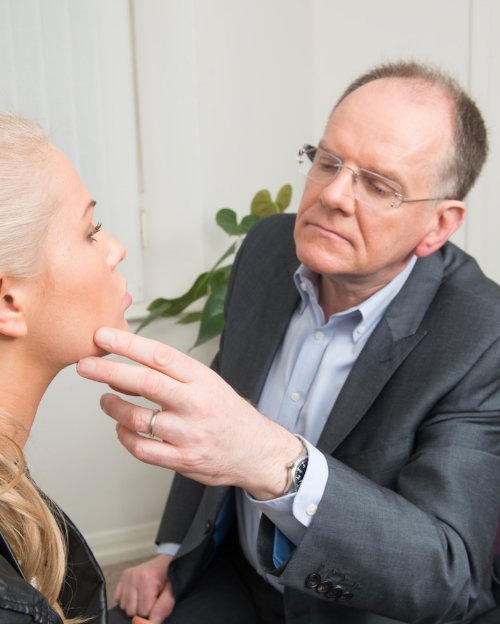
Good dermal filler treatment should preserve the features, proportions and expressions that make you look like you.
At our Surrey clinic our aim is that you still look like you, but a fresher and more relaxed version. We want your family and friends to say “You look well”.
Improvement Does Not Have to Mean Transformation
Dermal fillers can be used for very different purposes.
Sometimes they are used deliberately to alter or enhance a feature such as increasing lip volume, changing facial contours or creating greater definition.
But at the Cosmetic Doctors Company they are more often used to restore some of the changes that occur naturally with ageing.
As the face ages, there are changes in the skin, fat, bone and other supporting structures. Cheeks may become flatter, areas can become hollow and facial contours become less defined.
Carefully placed dermal filler can sometimes restore some of that lost support without substantially changing the person's underlying facial proportions.
The intention is not to create a new face. It is to make a relatively small adjustment to the existing one.
Why Are People So Worried About Looking Different?
Part of the problem is that we tend to notice unsuccessful or excessive filler far more readily than good filler. An obviously enlarged lip or disproportionately full cheek attracts attention. A subtle restoration of facial volume will not.
This creates a distorted impression of what dermal filler treatment normally looks like.
We have discussed this in Dermal Fillers — The Problem with Only Noticing the Bad Ones.
There is also an important difference between being able to see an improvement and being able to see the treatment.
Patients quite reasonably want to notice a difference themselves. The objective is not to perform a treatment so subtle that nothing has changed.
The ideal is that the improvement is visible without the filler becoming the defining feature of the face.
What Makes Someone Look “Overfilled”?
The word “overfilled” is commonly used, but it can describe several different things.
Sometimes there is simply too much volume in one area.
But a face can also look unnatural because its proportions have been altered. Lips may become too dominant for the surrounding features. Cheeks can become unusually prominent.
Repeated attempts to remove every hollow or line can produce a face that appears smoother but less anatomically convincing.
This is why natural-looking treatment cannot be judged simply by the number of millilitres used.
A small amount in an inappropriate place can alter a face unfavourably, while a larger amount used to restore genuine structural volume loss may remain remarkably unobtrusive.
The important question is not simply “How much filler?” It is “What are we trying to achieve?”
For a fuller explanation of the principles behind this, read Dermal Fillers: Achieving Natural, Subtle Results.
Enhancement and Alteration Are Not Quite the Same Thing
There is nothing inherently wrong with wanting to alter a facial feature.
Some patients deliberately want fuller lips, stronger contours or a more defined appearance. Provided expectations are realistic and treatment is appropriate, that is a perfectly legitimate aesthetic choice.
But it is different from the objective of many patients seeking treatment for age-related changes. They are usually not asking to acquire features they never had. They want to retain their own appearance while perhaps restoring some of what has changed.
That distinction matters.
For these patients, a successful result might be described as: “I look better, but I still look like me.”
Can Dermal Filler Make Me Look Younger?
Yes, sometimes they can, but that is not quite how I would define the objective.
Trying to make someone look dramatically younger can easily lead to excessive treatment. Ageing affects far more than facial volume, and filler cannot reverse every component of the ageing process.
A more realistic objective is often to make someone look less tired, better supported or more balanced, rather than attempting to recreate the face they had twenty years earlier.
Nor does every age-related change need correcting. Normal faces have lines, folds, shadows and asymmetries. Removing all of them would not necessarily make a face look younger. It may simply make it look treated.
Will Other People Be Able to Tell?
There is no way to guarantee what somebody else will notice.
But with subtle treatment, it is perfectly possible for an improvement to be apparent without its cause being obvious.
Someone may think you look well or rested. They may notice that something is slightly different without being able to identify what. For many of our patients, that distinction is precisely what they are looking for.
That is very different from a result where the first thing another person notices is the treatment itself.
The Aim Is Still to Look Like You
Dermal filler changes the face, that is, after all, why it is used. The important question is what kind of change.
Treatment can alter proportions and create new emphasis, or it can restore support and make relatively subtle improvements while preserving the character of the face.
Neither approach can be reduced simply to how much filler is used. For patients seeking a natural result, the objective is usually straightforward: to look like themselves, rather than like someone who has had dermal filler.
If you would like practical guidance on reducing the risk of an unnatural result, read How Do I Make Sure My Dermal Filler Results Look Natural?
If You Are Considering A Dermal Filler Treatment
A consultation allows you to explain what you would like to achieve and, equally importantly, what you do not want to change.
It also provides an opportunity to decide whether dermal filler is actually the appropriate treatment for your concern.
Consider Your Next Step
A consultation is where every good treatment starts. There will no obligation to proceed. The aim is to provide information and clarity, not pressure to have a treatment. All our consultations and treatments are performed by our team of expert medical doctors.
To arrange a consultation please use the links below to telephone or email or to fill out our contact form click here.