
Microneedling — What It Is, How It Works, and Why It Still Has a Place
One of aesthetic medicine's most established techniques explained, including some surprising science about topical products, and why not all microneedling is the same.
What microneedling actually does
Microneedling works by creating thousands of controlled micro-injuries in the epidermis and upper dermis using fine needles. These micro-injuries trigger the skin's natural wound healing cascade, unfolding in three phases: an initial inflammatory response in the first 24 to 72 hours, a proliferative phase during which new collagen and elastin fibres begin forming, and a remodelling phase that continues for weeks to months as the new collagen matures and reorganises.
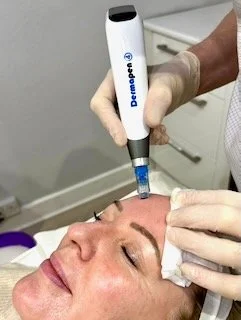
The result, across a properly delivered course of treatment, is genuine improvement in skin quality, firmness, texture, and tone. The procedure also stimulates new capillary formation in the treated dermis, an effect that contributes to the overall improvement in skin vitality.
Needle depth — and why it changes everything
The depth to which needles penetrate determines what is targeted and what clinical effect is produced. This is the single most important variable in microneedling and the one most consistently glossed over in the marketing of home and salon devices.
At 0.2 to 0.5mm, needles penetrate the epidermis and superficial dermis. This depth primarily enhances topical penetration and produces modest surface skin quality improvements. It does not reach the tissue depth required for meaningful collagen induction.
At 0.5 to 1.5mm, needles reach the papillary dermis and initiate genuine formation of new collagen fibres that produces the structural skin improvements microneedling is known for.
At 1.5 to 2.5mm, the reticular dermis is targeted, producing the most significant collagen stimulation and the most clinically meaningful results along with the most significant post-procedure recovery requirement.
Home, beauty salon, and medical - they are not the same procedure
This is where clarity matters most, because the marketing around microneedling frequently implies equivalence where none exists.
Home dermarollers — widely available and heavily promoted on social media — typically operate at depths of 0.2 to 0.5mm. At this depth, they do not produce meaningful collagen induction. Their primary effect is enhanced absorption of topical products applied afterwards.
Used carefully with appropriate products, they have a modest role in a home skincare routine. Used carelessly, or with the wrong products, the enhanced penetration they create can drive irritants deeper into the skin and cause more harm than benefit. The claim that a home dermaroller produces the same results as a professional microneedling treatment is not supported by the biology.
Beauty salon microneedling occupies a more complicated middle ground. In the UK, regulations around who can perform microneedling at what depth are not consistently enforced, and the training and oversight of non-medical practitioners varies enormously.
Treatments at depths of 0.5 to 1.0mm can produce some degree of collagen stimulation in appropriately trained hands, but the absence of medical oversight, the inability to manage complications, and the frequent lack of a proper clinical assessment before treatment are meaningful concerns. The needle depth achievable in a salon setting is also typically limited by regulation and by the practitioner's training.
Medical microneedling, performed by a qualified clinician using a motorised device at appropriate depth for the individual patient's skin and concern, is a different procedure in clinical terms. The depth is calibrated to the specific indication. The wound healing cascade is genuinely triggered. Post-procedure management is medically informed. And the full range of appropriate topical adjuncts, including prescription-grade ingredients and evidence-based growth factors, can be used safely and purposefully within the treatment protocol.
The topical penetration question — and a surprising finding
One of the most discussed aspects of microneedling is its ability to enhance the penetration of topically applied actives. This is a genuine effect — but the science is more nuanced than most protocols acknowledge.
Research has shown that microneedled skin recovers its barrier properties within approximately two hours. More surprisingly, studies have found that topical agents applied just before microneedling penetrate deeper than those applied immediately afterwards — challenging the standard assumption that products should simply be applied after the procedure.
The safety implication is equally important. The microchannels created by needling cannot distinguish between beneficial compounds and irritants. In the immediate post-procedure window, simpler is safer.
Worth applying post-procedure: hyaluronic acid, growth factors, PDRN, and ceramide-based formulations to assist barrier recovery.
Avoid immediately post-procedure: retinoids, high-concentration vitamin C, AHAs, BHAs, and any ingredient with known irritant potential.
What microneedling treats well
The strongest clinical evidence is for acne scarring where multiple sessions produce genuine dermal remodelling.
Skin quality improvement across texture, tone, and overall dermal vitality is consistently demonstrated.
There is also credible evidence for stretch marks, certain presentations of hyperpigmentation, and hair loss in combination with topical minoxidil.
Where it sits alongside newer technologies
Radiofrequency microneedling and other energy-based devices have expanded the treatment landscape considerably. Standard microneedling retains a meaningful role alongside them; producing genuine collagen induction without the thermal component, making it a safer choice for patients with darker skin types, and at a cost profile that makes a full course more accessible. The topical penetration enhancement it provides, properly understood and managed, adds a dimension that energy-based alternatives cannot replicate in the same way.
Read here for more about microneedling.
Consider Your Next Step
A consultation is where every good treatment starts. There will no obligation to proceed. The aim is to provide information and clarity, not pressure to have a treatment. All our consultations and treatments are performed by our team of expert medical doctors.
To arrange a consultation please use the links below to telephone or email or to fill out our contact form click here.
References
Tehrani L et al. Physiological Mechanisms and Therapeutic Applications of Microneedling: A Narrative Review. Cureus. 2025. https://pmc.ncbi.nlm.nih.gov/articles/PMC11993440/
Recent Advances in Microneedling-Assisted Cosmetic Applications. Cosmetics. 2024;11(2):51. https://www.mdpi.com/2079-9284/11/2/51
Factors Affecting Depth of Penetration in Microneedling and Laser-Assisted Drug Delivery: The Importance of Timing of Topical Application. PubMed. 2020. https://pubmed.ncbi.nlm.nih.gov/32205757/
Kinetics of Skin Resealing After Insertion of Microneedles in Human Subjects. PMC. 2011. https://pmc.ncbi.nlm.nih.gov/articles/PMC3164267/