
The Frozen Face in Aesthetic Medicine — Separating Fact from Fiction
Or Why Do Some Celebrities have Frozen Faces ?
The faces that concern patients most are almost always the result of multiple procedures compounded over many years, often multiple facial operations, filler and Botox all playing a part. No single treatment is responsible, but each amplifying the effect of the others - and Botox taking the blame.
Introduction
At the Cosmetic Doctors Company in Surrey , almost every patient who comes to us considering wrinkle-relaxing injections raises the same concern, they don't want to look too frozen. They will often reach for their phone to show a photograph of a celebrity, pointing to a face that looks strangely immobile, oddly smooth, or somehow just not quite right. Read how this look distorts the public perception in Dermal Fillers - The Problem with Only Noticing the Bad Ones.
It is an entirely understandable fear. And it deserves a straightforward answer
The frozen face, when it occurs, is never the result of botulinum toxin alone. Understanding what actually produces that look, and why botulinum so often takes the blame for it, is the first step towards approaching treatment with confidence rather than anxiety.
What Patients Are Actually Seeing
When patients show us those celebrity photographs, they are usually looking at a face that has undergone years of multiple, overlapping procedures and botulinum is only one small component of a much more complex picture.
Excessive dermal filler is frequently responsible for the puffy, mask-like quality that reads as unnatural. When filler is placed in large volumes, repeatedly, over many years, it can accumulate and distort the natural proportions of the face in ways that have nothing to do with muscle relaxation.
Surgery plays a highly significant role. The telltale tightness of a face that has been lifted one too many times, the pulled appearance, the distorted hairline, the unnatural tension around the eyes and mouth is the consequence of repeated surgical intervention, not Botox. And yet that look, familiar from decades of Hollywood excess, has become inextricably associated in the public mind with "too much Botox."
The reality is that botulinum toxin, used alone and in appropriate doses, cannot produce the kind of dramatic facial distortion that patients fear. It relaxes specific muscles. It does not fill space, alter structure, or pull tissue. The frozen faces that have shaped public perception are almost always the product of a combination of treatments, applied excessively and without sufficient restraint — and botulinum is simply the easiest target.
What Actually Causes That Look
The frozen, mask-like appearance that patients are genuinely concerned about, the kind seen in those celebrity photographs, is not something botulinum toxin can produce on its own. Its mechanism simply does not allow for it. Botulinum relaxes the specific muscles causing frown lines, horizontal forehead lines and crow’s feet.
It cannot alter facial structure or create the pulled tightness that comes from repeated surgery, or the puffed immobility that results from years of accumulated filler.
When botulinum is poorly placed a different kind of problem may result. Perhaps a heavy or unnatural appearance in the forehead, and elevation or depression of the eyebrows. That is worth avoiding, and it is why technique and restraint matter enormously.
For more information about Botox look at our Anti-Wrinkle Treatment page.
But it is a quite different phenomenon from the Hollywood frozen face that has shaped so much patient anxiety. The two are regularly confused, and the confusion is unfair to a Botox treatment.
The Spectrum of Expectation
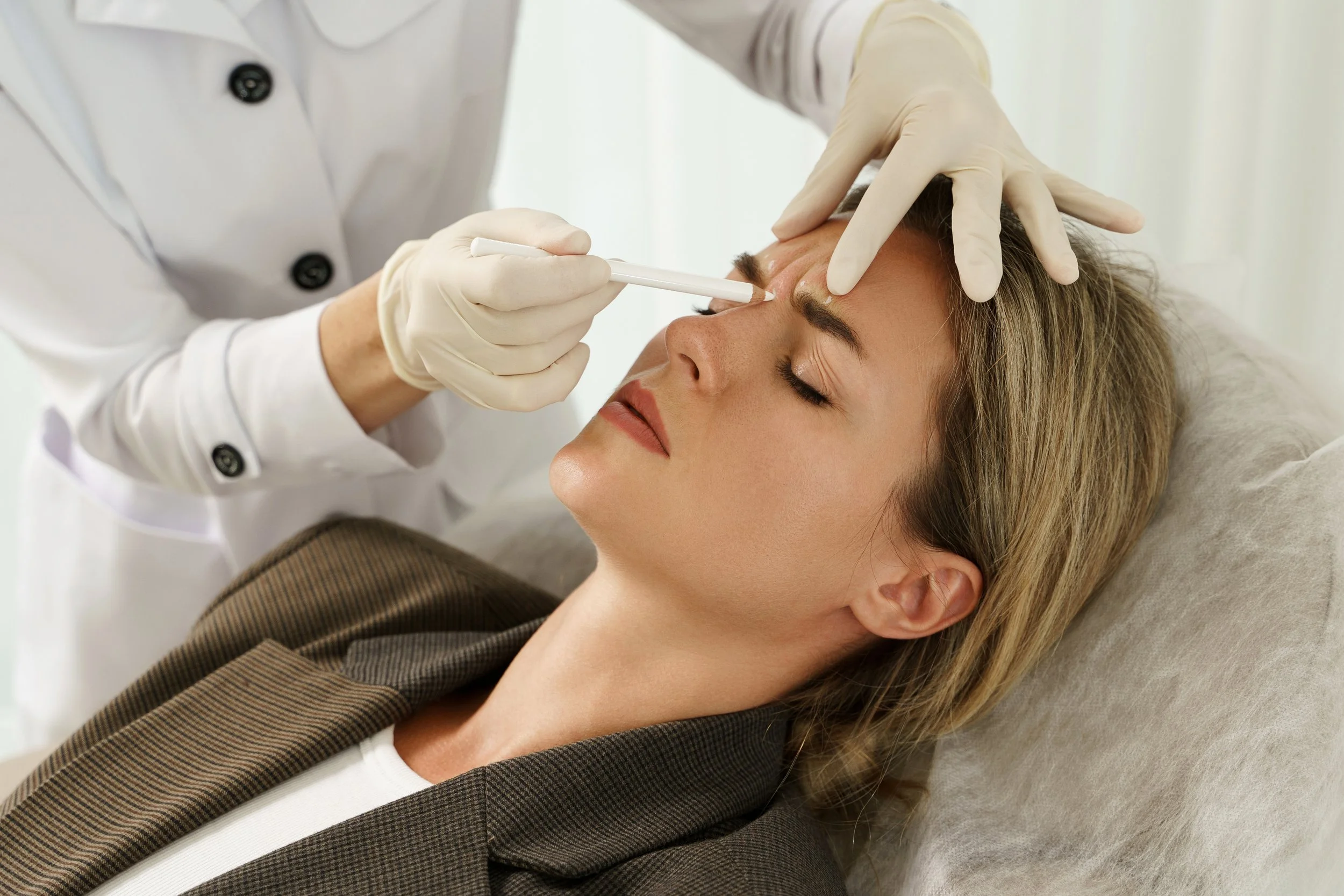
It is worth acknowledging that patients vary in what they want from treatment and a good practitioner works within that range.
Some patients, particularly those who have been having treatment for many years, are comfortable with significant reduction in forehead movement and find that approach gives them a longer duration between sessions. Others, as attitudes towards aesthetic treatment continue to mature, want something far subtler. A quiet freshening of their appearance. Natural movement fully preserved. A result that prompts people to comment that they look well, rather than to ask what they have had done.
Both are entirely valid goals. The role of an experienced practitioner is to understand where each individual sits on that spectrum and treat accordingly — not to apply a standard protocol to every face.
It is also worth remembering that even when forehead movement is significantly reduced, the rest of the face continues to animate fully and naturally. The eyes, the mouth, the mid-face — expression is not lost. And in most cases, even a more complete treatment of the forehead goes entirely unnoticed by anyone other than the patient themselves.
Conclusion
The frozen face is real, but it is far from inevitable, and it is not the fault of Botox. It is the consequence of excess, applied without sufficient skill or restraint.
Approached thoughtfully, by an experienced medical practitioner, wrinkle-relaxing injections produce results that are natural, subtle, and entirely undetectable. The goal is never to change how a patient looks. It is simply to allow them to look their best, without anyone quite being able to say why.
If you are considering a treatment
A consultation is your appropriate first step, allowing you to make a fully informed decision without any pressure. All our treatments are performed by our medically qualified doctors, who bring both clinical expertise and genuine aesthetic judgement to every consultation.
Find out here What Happens at Your First Aesthetic Consultation
and Why Your Consultation Matters More Than Your Treatment.
To Book a Consultation
If you would like to explore any of our curated range of services, we would be pleased to arrange a consultation. At the Cosmetic Doctors Company your consultation and any subsequent treatment will always be with one of our expert, medically qualified doctors.
To make a booking with one of our doctors please use the links below to telephone or email or to fill out our contact form click here.