Treatment of Post-Acne Facial Scarring
Active acne clears. The scars it leaves behind often do not, not without treatment.
Here is a look at how we approach post-acne scarring at the Surrey-based Cosmetic Doctors Company, and why the combination of microneedling, PDRN, tretinoin and, in selected cases, superficial dermal filler tends to give the most reliable results.
What causes post-acne scarring?
Acne scarring is the result of inflammation damaging the dermis during active breakouts. As the skin repairs itself, it can either overproduce collagen, leaving raised scars, or underproduce it, leaving the depressed rolling, boxcar and ice pick scars that are far more common on the face.
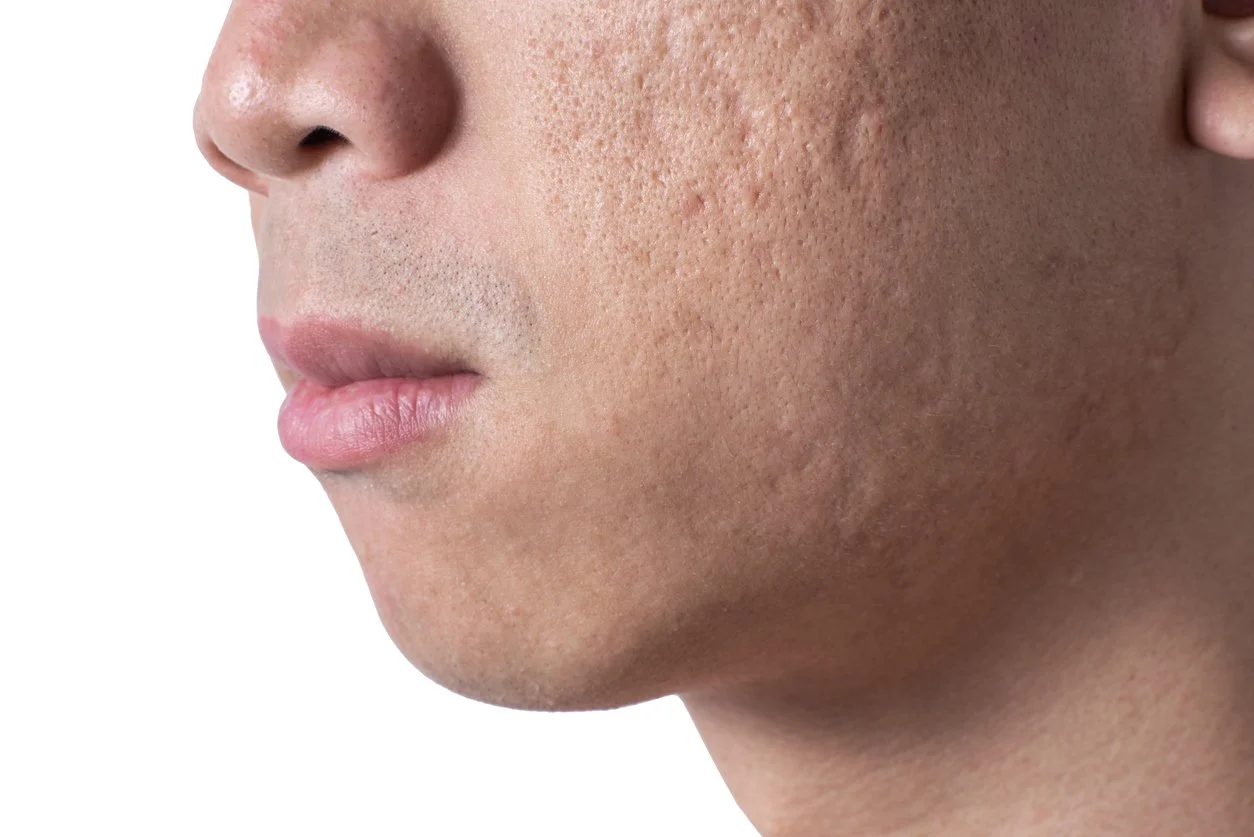
Post-acne scarring often lingers well beyond the acne itself, and its impact is rarely just physical. It can become a quiet source of self-consciousness long after their skin has otherwise settled.
Once the acne itself has settled, these textural changes tend to persist indefinitely without intervention, because the dermal architecture has been genuinely disrupted, not simply marked.
Why is microneedling the foundation of treatment?
Microneedling works by creating controlled micro-injuries in the dermis, triggering the same wound-healing cascade that produces new collagen and elastin, this time in a more organised and even distribution than the original acne damage. For acne scarring specifically, needle depth matters. Read why microneedling still has a place in modern aesthetic practice.
On the face, we work at 1.5 to 2mm, deep enough to reach the papillary and upper reticular dermis where genuine remodelling occurs, without straying into territory that increases risk unnecessarily. The 0.3mm ~ 1.0mm needling often offered by non-medical practitioners is completely inadequate for this indication..
A course of three treatments, spaced four to six weeks apart, allows each round of collagen remodelling to complete before the next session begins. Scarring rarely responds fully to a single treatment; it is a cumulative process. See our medical microneedling treatment page for more information.
What is Medik8 Exo-PDRN Professional Concentrate, and why use it alongside microneedling?
During microneedling, the skin's channels remain open for a short window afterwards, and this is a genuine opportunity rather than simply a moment to avoid irritants. We use Medik8's Exo-PDRN Prismatic+ Pro Concentrate at this stage specifically, because it is formulated for use while the channels are open, allowing PDRN (polydeoxyribonucleotide) and exosome technology to reach the dermis at a point when penetration is meaningfully enhanced.
PDRN has a growing evidence base for supporting tissue repair and fibroblast activity, which makes it a rational adjunct to the mechanical stimulus of the needling itself, rather than a separate, unrelated step.
What role does tretinoin play?
Tretinoin is started four weeks before either microneedling or dermal filler treatment begins, and continues throughout the programme. Started early, it increases epidermal turnover and dermal collagen synthesis in its own right, meaning the skin arrives at the first microneedling session already primed to respond.
Continued throughout the course, it supports and extends the remodelling triggered by each session, rather than the two therapies working in isolation from one another. Read about the importance ofTretinoin in skin rejuvenation.
One practical point worth stressing, tretinoin should not be applied on the same day or the day following microneedling. It has no place in the immediate post-needling window, when the skin's barrier is temporarily compromised and irritant potential is significantly higher.
Can dermal filler treat acne scarring?
For scars with genuine volume loss rather than pure textural irregularity, particularly rolling scars, a superficial hyaluronic acid filler can lift the base of the scar to sit level with the surrounding skin. This is a different mechanism to microneedling, filling rather than stimulating, and the two approaches are complementary rather than competing. Not every patient needs filler; it is reserved for scars where volume, not just texture, is the primary problem.
What does a realistic treatment programme look like?
In practice, this means: tretinoin started four weeks ahead of any procedure, three microneedling sessions at 1.5 to 2mm depth spaced four to six weeks apart with Exo-PDRN Prismatic+ Pro Concentrate applied immediately post-treatment, tretinoin continued throughout, and superficial HA filler added where volume loss warrants it. Results build gradually and become genuinely visible over several months, in keeping with how dermal remodelling actually works.
If you are considering treatment, a consultation is your appropriate first step, allowing you to make a fully informed decision without any pressure.