
Biostimulation in Aesthetic Medicine — The Future of Natural Skin Rejuvenation
Biostimulation in Aesthetic Medicine, also known as bio-rejuvenation or regenerative medicine
The Science of Natural Skin Rejuvenation
Aesthetic medicine is undergoing a genuine scientific shift
For many years, the dominant approach was straightforward: replace what has been lost. Restore volume. Smooth lines. The tools for doing so e.g. dermal fillers and wrinkle-relaxing injections remain valuable and still have an important role. But they address the visible consequences of ageing rather than its underlying biology.
A newer, more sophisticated approach is now gaining ground. Rather than adding to the face, biostimulatory treatments work by encouraging the skin to regenerate itself — improving tissue quality from within, at a cellular level.
At the Cosmetic Doctors Company in Esher, Surrey, this represents a more considered and medically sound approach to aesthetic care. In this post we explain the science clearly — what biostimulation actually is, how different treatments achieve it, and why results tend to be more natural and longer lasting.
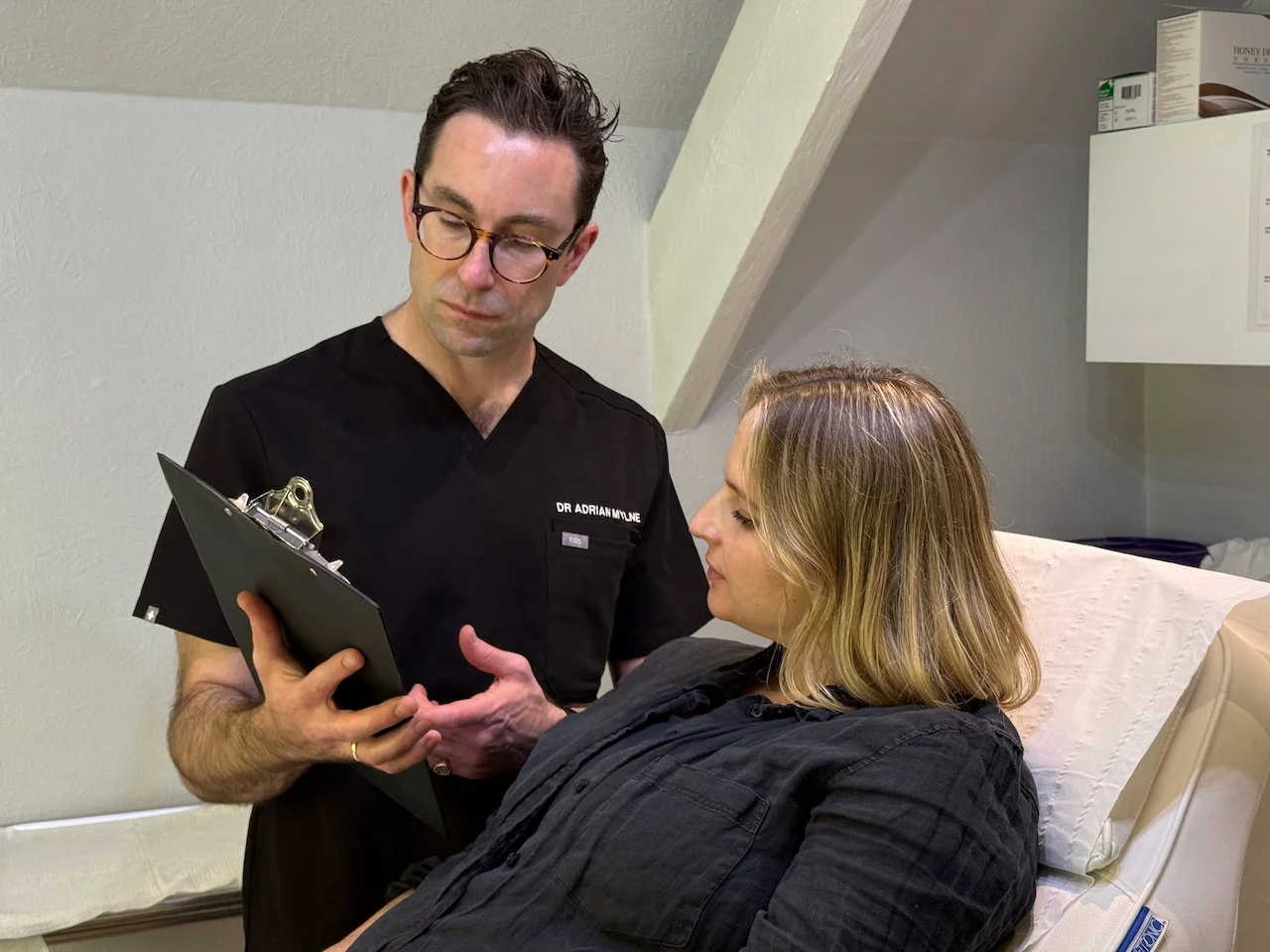
At the Cosmetic Doctors Company your consultation and any subsequent treatment will always be with one of our doctors.
What Happens to Skin as We Age?
To understand biostimulation, it helps to understand what ageing does to skin at a structural level.
The skin is supported by an intricate framework called the extracellular matrix, composed of mainly collagen and elastin, that gives skin its firmness, elasticity and structural integrity. Woven through this framework is hyaluronic acid, keeping the tissue hydrated and supple.
The cells responsible for maintaining this framework are fibroblasts. From our mid-twenties onwards, fibroblast activity gradually declines and the associated production of collagen, elastin and hyaluronic acid slows. At the same time, the enzymes that break down collagen become relatively more active.
The cumulative effect over decades is the visible appearance of ageing: reduced firmness, loss of elasticity, diminished hydration, and a gradual thinning of the skin.
Biostimulation addresses this process at its source. Rather than filling the space left by lost volume, it aims to reactivate the skin's own repair mechanisms — encouraging fibroblasts to resume the work of producing structural proteins, and restoring the integrity of the extracellular matrix itself.
What Is Biostimulation?
Biostimulationalso referred to as regenerative aesthetics or bio-regeneration describes treatments that stimulate the body's own biological processes to improve tissue quality.
The key distinction from traditional fillers is this: biostimulatory treatments do not create immediate visible change by adding volume or filling space. Instead, they deliver a biological signal that triggers the production of new collagen, elastin and improved hydration.
Results develop gradually over weeks to months, as new structural proteins are synthesised and integrate into the skin. The outcomes are subtler in character, and typically longer lasting, than those achieved by volume replacement alone.
Why These Treatments Produce More Natural Results
The results of biostimulatory treatments tend to look and feel more natural for a specific reason: the tissue that develops is the patient's own.
Rather than introducing a foreign substance to fill space, biostimulation recruits the skin's own fibroblasts to produce structural proteins in an organised, physiological way. The skin matrix becomes more like younger tissue — not because something has been added from outside, but because the skin's own biology has been reactivated.
Results develop gradually over weeks to months, which means the change is almost imperceptible on a day-to-day basis. Patients typically appear refreshed rather than treated.
The Role of Treatment Planning
Biostimulation is rarely a single-session solution. Because these treatments work through biological processes that take time, a course of treatment — with appropriate maintenance — is usually required to achieve and sustain meaningful results.
The specific approach will vary considerably depending on age, skin quality, degree of laxity, and individual goals. For some patients, a biostimulatory treatment may be all that is needed. For others, it may form part of a broader plan that also includes conservative use of dermal fillers or wrinkle-relaxing injections.
This is why a careful, unhurried consultation is essential. There is no meaningful default protocol. The right treatment, in the right combination, at the right time, is what produces results that are both clinically effective and genuinely natural in appearance.
Read What Happens at Your First Aesthetic Consultation and Why Your Consultation Matters More Than Your Treatment
Biostimulatory treatments represent a scientifically grounded and increasingly important approach to aesthetic medicine. By working with the skin's own biology — reactivating fibroblasts, rebuilding the extracellular matrix, and restoring the structural proteins that diminish with age — they offer a pathway to results that are natural, gradual, and longer lasting than those achieved by volume replacement alone.

At the Cosmetic Doctors Company we believe this approach is very much the future and sits at the heart of our aesthetic practice.
How Each Biostimulatory Treatment Works
Several treatments fall within this category, but their mechanisms are meaningfully different. Understanding how each works helps to explain when and why a particular approach might be recommended.
Sculptra (Poly-L-Lactic Acid)
Sculptra has been in clinical use for over 25 years. It is composed of biodegradable poly-L-lactic acid (PLLA) microparticles that work through a well-characterised biological mechanism.
When injected, the PLLA microparticles are too large to be engulfed by neutrophils and therefore persist in the tissue long enough to initiate a controlled, self-limiting inflammatory response. This involves the release of growth factors that activate dermal fibroblasts and upregulate gene expression for collagen types I and III. The result is a sustained process of new collagen growth that continues as the PLLA particles slowly degrade over many months.
Clinical studies have demonstrated an increase in Type I collagen of up to 65% at three months following treatment, with effects persisting for up to two years. More recent gene expression research has shown that PLLA also has epigenetic effects — altering gene activity patterns in ways that promote ongoing collagen synthesis and tissue regeneration.
Unlike most biostimulatory treatments, Sculptra can also achieve meaningful volumetric change over time, making it particularly useful for addressing facial laxity and structural volume loss, as well as global skin quality. Read more about Sculptra.
Read about Sculptra vs Profhilo: Which Treatment Is Right for You?
Profhilo
Profhilo is a stabilised hyaluronic acid preparation manufactured using a patented thermal process that combines high and low molecular weight hyaluronic acid.
The two components serve distinct but complementary purposes. The high molecular weight fraction creates a stable hydrating structure in the dermis. The low molecular weight fraction is released gradually and acts on fibroblasts, stimulating production of collagen and elastin. Importantly, this release is slow enough that it does not trigger the acute inflammatory response associated with free low molecular weight hyaluronic acid — making Profhilo notably well tolerated.
Published studies have demonstrated that these hybrid complexes stimulate the production of four types of collagen — types I, III, IV and VII — as well as elastin, to a significantly greater degree than either high or low molecular weight hyaluronic acid used alone. The result is genuine bio-remodelling of the skin rather than simple hydration.
Clinically, Profhilo spreads through the interstitial spaces of the dermis from a small number of precise injection points, improving tissue quality across a broader area than conventional filler treatments. It also stimulates adipose-derived stem cells to differentiate into fibroblasts, further supporting tissue regeneration. Read more about Profhilo
Read about Sculptra vs Profhilo: Which Treatment Is Right for You?
Polynucleotides
Polynucleotides are fragments of purified DNA, typically derived from salmon, chosen for its high compatibility with human tissue. Once injected into the dermis, they work through a distinct and elegant mechanism.
Rather than causing tissue injury or triggering an inflammatory cascade, polynucleotides bind to specific cell surface receptors — particularly receptors on fibroblasts — activating signalling pathways that the skin already uses naturally during repair. This stimulates fibroblast proliferation and increases the production of collagen, elastin and hyaluronic acid.
In addition, polynucleotides form a scaffold-like structure in the dermis that physically attracts and retains water, improving tissue hydration and structural support. They also have anti-inflammatory and antioxidant properties, and improve vascularisation — enhancing the delivery of oxygen and nutrients to the treated tissue.
The collagen produced as a result of polynucleotide treatment is organised and structural, more analogous to naturally maintained tissue than the collagen laid down in response to injury. This is one of the reasons the results tend to appear particularly natural.
Published clinical research has shown measurable increases in fibroblast proliferation and collagen synthesis within four weeks of treatment, with improvements in elasticity, hydration and overall skin quality confirmed across multiple studies. Read more about Polynucleotides.
Hyper-Dilute Radiesse (Calcium Hydroxylapatite)
Radiesse is composed of calcium hydroxylapatite microspheres — a mineral that occurs naturally in bone. When prepared in a highly diluted form, it functions as a biostimulator rather than a volumising filler.
The calcium hydroxylapatite particles act as a scaffold and stimulate fibroblasts to produce collagen and elastin through a mechanism that appears distinct from that of PLLA. Gene expression studies suggest it primarily promotes collagen types I and III through different signalling pathways, making it a complementary rather than equivalent agent to Sculptra in regenerative treatment planning.
Hyper-dilute Radiesse is particularly effective for skin quality improvement across larger surface areas, including the neck, décolletage and hands
If you are considering treatment, a consultation is your appropriate first step, allowing you to make a fully informed decision without any pressure. Understand why your consultation matters more than your treatment.
To Book a Consultation :
If you would like to explore any of our curated range of services, we would be pleased to arrange a consultation. At the Cosmetic Doctors Company your consultation and any subsequent treatment will always be with one of our expert, medically qualified doctors.
To make a booking with one of our doctors please use the links below to telephone or email or to fill out our contact form click here.